Connect with us

Earth

Mars and Venus: The Ultimate Guide to Earth’s Neighboring Planets in 2026

Published

on

Mars and Venus: The Ultimate Guide to Earth's Neighboring Planets in 2026

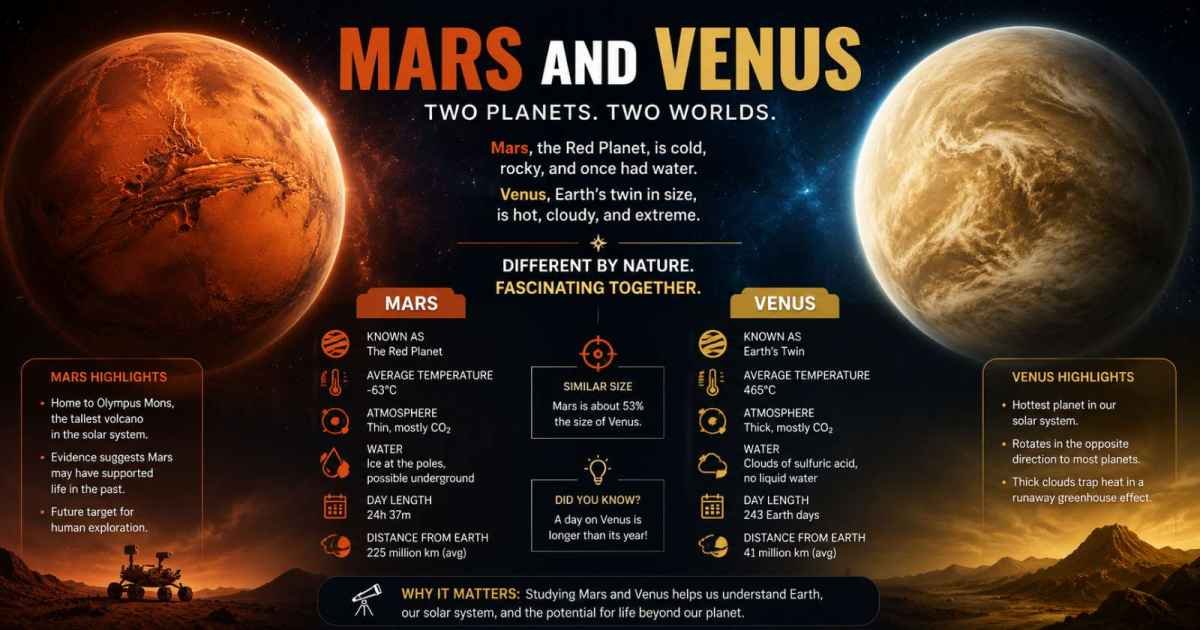
When we look at our solar system, Mars and Venus stand out as Earth’s closest planetary neighbors and two of the most fascinating worlds ever discovered. While both are classified as terrestrial planets, they have evolved into dramatically different environments. Venus is a blazing-hot world hidden beneath thick clouds, while Mars is a cold, dusty desert that may once have supported rivers, lakes, and possibly even life.

In 2026, interest in both planets has reached new heights thanks to ongoing discoveries, future exploration missions, and humanity’s long-term dream of exploring—and perhaps even living beyond—Earth. This complete guide explores everything you need to know about Mars and Venus, from their atmospheres and geology to the latest missions and their importance for our future.

What Are Mars and Venus? An Overview

Mars and Venus are Earth’s nearest neighboring planets, but they earned the nickname Earth’s sister planets for very different reasons.

Venus is the second planet from the Sun, orbiting at an average distance of 108 million kilometers (67 million miles). It is remarkably similar to Earth in size, mass, gravity, and density, making it the closest physical twin of our home planet.

Mars, meanwhile, is the fourth planet from the Sun, orbiting approximately 228 million kilometers (142 million miles) away. Although much smaller than Earth, Mars has a day length, seasonal cycle, and axial tilt surprisingly similar to our own planet.

The greater distance from the Sun explains much of the difference between these two worlds. Venus became a runaway greenhouse furnace, while Mars gradually lost most of its atmosphere and transformed into a frozen desert.

Both planets have been visible to the naked eye since ancient times and inspired countless myths and civilizations. Modern telescopes, orbiters, and robotic explorers have revealed that these neighboring planets are among the most scientifically valuable destinations in our solar system.

Atmosphere and Climate: Two Worlds of Extreme Opposites

The atmosphere is where Mars and Venus differ the most.

Venus: The Hottest Planet

Despite being farther from the Sun than Mercury, Venus is the hottest planet in the solar system.

Its atmosphere consists of approximately:

  • 96.5% carbon dioxide
  • Thick clouds of sulfuric acid
  • Trace amounts of nitrogen and other gases

This dense atmosphere produces an extreme runaway greenhouse effect, trapping enormous amounts of heat.

Key facts include:

  • Average surface temperature: 462°C (864°F)
  • Atmospheric pressure: 92 times Earth’s pressure
  • Hot enough to melt lead
  • Constant cloud cover hides the surface completely

Standing on Venus would feel like being almost 900 meters underwater because of the immense atmospheric pressure.

Mars: The Frozen Desert

Mars has almost the opposite problem.

Although its atmosphere is also mostly carbon dioxide (around 95%), it is about 100 times thinner than Earth’s, making it unable to retain much heat.

Typical temperatures include:

  • Average temperature: −65°C (−85°F)
  • Winter poles: −153°C
  • Summer equator: up to 20°C

Mars also experiences gigantic planet-wide dust storms that sometimes last for months and cover nearly the entire planet.

Simply put:

  • Venus is too hot
  • Mars is too cold

Neither world currently supports human life naturally.

Surface and Geology: Volcanoes, Mountains, and Ancient Landscapes

Although hidden beneath clouds or covered in dust, both planets possess spectacular geological features.

Venus

The surface of Venus is estimated to be 300–500 million years old, making it relatively young compared to many planetary surfaces.

Its landscape includes:

  • Vast volcanic plains covering around 80% of the planet
  • Thousands of volcanic structures
  • Massive shield volcanoes like Maat Mons
  • Unique fractured terrains known as tesserae
  • Thousands of impact craters

Recent scientific studies suggest Venus may still be volcanically active, making it one of the few geologically active rocky planets in the solar system.

Mars

Mars preserves billions of years of geological history.

Its incredible landmarks include:

  • Olympus Mons, the largest volcano in the solar system, nearly 22 kilometers high
  • Valles Marineris, a canyon stretching over 4,000 kilometers, reaching depths of nearly 7 kilometers
  • Ancient river valleys
  • Dry lake beds
  • Polar ice caps composed of water ice and frozen carbon dioxide

Mars gets its famous red appearance from iron oxide (rust) coating its surface.

These ancient landscapes strongly suggest Mars once possessed abundant liquid water flowing across its surface.

Water, Life, and Habitability: Could Either Planet Support Life

One of the greatest scientific questions remains:

Has life ever existed on Mars or Venus?

Mars: The Best Candidate

Evidence continues to grow that early Mars was dramatically different.

Scientists have discovered:

  • Ancient river systems
  • Long-lived lakes
  • Clay minerals formed in water
  • Organic molecules
  • Large underground ice deposits

NASA’s Curiosity and Perseverance rovers have collected compelling evidence that Mars was once warm enough for liquid water.

Although no life has yet been found, many researchers believe ancient microbial life remains entirely possible.

Planning continues for future Mars Sample Return efforts that aim to bring Martian rock samples back to Earth for detailed laboratory analysis.

Venus: Life in the Clouds?

Venus may also have once been surprisingly habitable.

Computer models suggest that billions of years ago Venus may have possessed:

  • Oceans
  • Moderate temperatures
  • Stable climates

Today the surface is completely hostile.

However, around 50 kilometers above the surface, temperatures and pressures become remarkably Earth-like.

Interest increased dramatically after scientists reported possible detection of phosphine gas in Venus’ clouds in 2020. Although the finding remains debated, it inspired renewed exploration focused on determining whether microbial life could exist within Venus’ upper atmosphere.

Moons, Rotation, Seasons, and a Day on Each Planet

Mars and Venus behave very differently in space.

Venus

Venus is one of only two planets without moons.

Its rotation is extraordinarily unusual:

  • Spins backwards (retrograde rotation)
  • One day lasts 243 Earth days
  • One year lasts only 225 Earth days

That means a single day on Venus is actually longer than its year.

The Sun would appear to rise in the west and set in the east.

Mars

Mars has two tiny moons:

  • Phobos
  • Deimos

These are believed to be captured asteroids.

Mars also shares several characteristics with Earth:

  • One Martian day (sol) lasts 24 hours 37 minutes
  • Axial tilt of 25°
  • Four distinct seasons
  • One Martian year equals 687 Earth days

Because of its familiar day-night cycle, Mars remains the most practical candidate for future human settlement.

Exploration Missions: Past, Present, and Future in 2026

Both planets have been extensively explored by robotic spacecraft.

Exploring Venus

Historic milestones include:

  • Soviet Venera missions becoming the first spacecraft to land successfully on another planet
  • NASA’s Magellan mission mapping almost 98% of Venus using radar
  • Japan’s Akatsuki spacecraft continuing atmospheric observations

The coming decade promises renewed excitement with missions such as:

  • NASA VERITAS
  • NASA DAVINCI
  • ESA EnVision

These missions aim to study Venus’ geology, atmosphere, volcanic activity, and possible past habitability.

Exploring Mars

Mars remains humanity’s most explored planet after Earth.

By 2026, dozens of successful missions have transformed our understanding of the Red Planet.

Major active explorers include:

  • Perseverance Rover
  • Curiosity Rover
  • Multiple orbiters from NASA, ESA, China, India, and the United Arab Emirates

The historic Ingenuity helicopter also demonstrated the first powered flight on another planet, opening a new chapter in planetary exploration.

Looking ahead, SpaceX Starship, NASA’s Artemis program, and international partnerships continue laying the groundwork for the first human missions to Mars during the 2030s.

Mars vs Venus: Which Planet Matters More for Humanity?

Although both planets are scientifically invaluable, they serve different purposes.

FeatureVenusMars
Planet TypeTerrestrialTerrestrial
Size95% of Earth’s diameter53% of Earth’s diameter
Average Temperature462°C−65°C
AtmosphereExtremely thickExtremely thin
MoonsNonePhobos & Deimos
Potential for ColonizationVery LowHighest after Earth
Scientific ImportanceClimate evolutionSearch for life & future settlement

Venus teaches scientists about the devastating consequences of runaway climate change, offering valuable insights into planetary evolution and atmospheric science.

Mars, meanwhile, represents humanity’s greatest opportunity for becoming a multi-planetary civilization. It possesses accessible water ice, useful mineral resources, manageable day lengths, and conditions that may eventually support long-term human habitats.

Conclusion

Mars and Venus represent two dramatically different paths that rocky planets can follow. One became an uninhabitable furnace, while the other transformed into a cold and barren desert. Together, they help scientists understand planetary evolution, climate, geology, and the conditions necessary for life.

As exploration accelerates throughout 2026 and beyond, new robotic missions, improved technologies, and ambitious plans for human exploration promise to reveal even more secrets. Whether uncovering evidence of ancient Martian microbes or investigating the mysterious clouds of Venus, these neighboring worlds continue to expand our understanding of the universe—and of Earth itself.

Studying Mars and Venus is not simply about exploring distant planets. It is about discovering where we came from, how planets evolve, and where humanity’s future among the stars may ultimately lead.

Continue Reading

Trending