
Art
Andrea del Verrocchio: The Forgotten Master of the Italian Renaissance (2026 Guide)

Published
3 months agoon
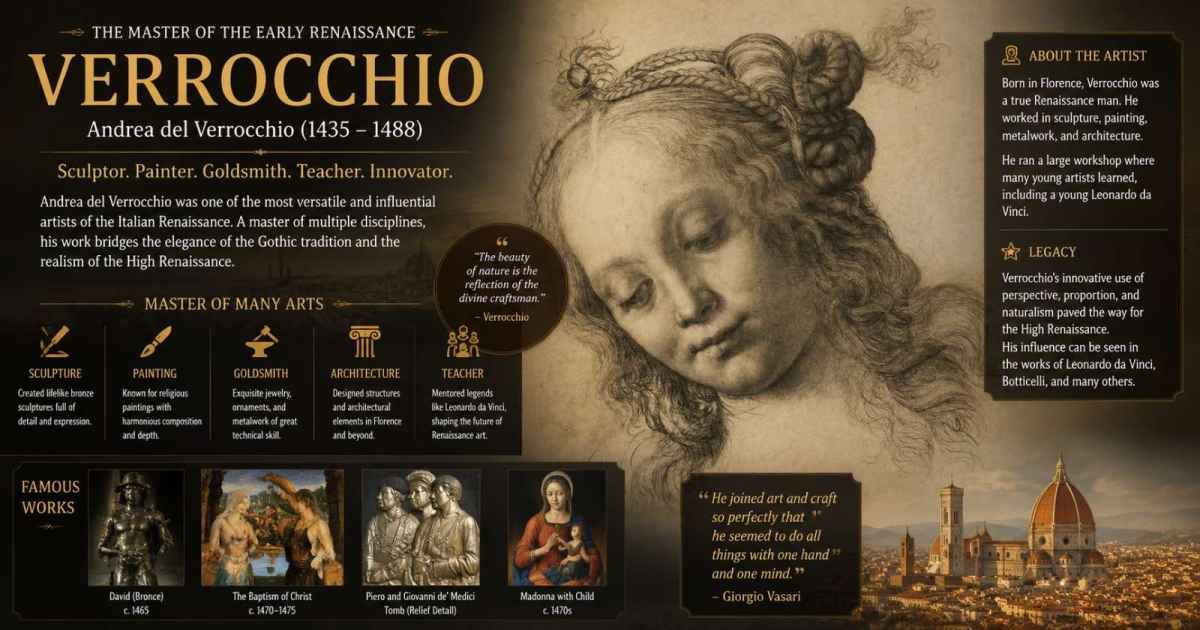
Table of Contents
ToggleWhen discussing the Italian Renaissance, names like Leonardo da Vinci, Michelangelo, and Raphael usually dominate the conversation. Yet behind one of history’s greatest artistic revolutions stood a remarkable master whose influence shaped an entire generation of artists—Andrea del Verrocchio.
Born as Andrea di Michele di Francesco de’ Cioni around 1435 in Florence, Verrocchio was a master goldsmith, sculptor, painter, draftsman, engineer, and teacher. Although often remembered as Leonardo da Vinci’s mentor, his own artistic achievements rank among the finest of the Early Renaissance. His sculptures display extraordinary realism, his paintings demonstrate technical brilliance, and his workshop became the training ground for many of Italy’s future artistic legends.
If you’re searching for the complete biography, famous artworks, artistic style, workshop, and lasting legacy of Andrea del Verrocchio, this comprehensive 2026 guide covers everything you need to know.
Who Was Andrea del Verrocchio? Biography and Early Life
Andrea del Verrocchio was born in Florence, Republic of Florence, around 1435. His birth name was Andrea di Michele di Francesco de’ Cioni. The nickname “Verrocchio” is generally believed to have come from the goldsmith who trained him, although another popular tradition connects it to the Italian phrase “vero occhio,” meaning “true eye,” referring to his exceptional artistic observation and precision.
Growing up during Florence’s cultural golden age, Verrocchio was surrounded by innovation in art, architecture, science, and philosophy. Instead of beginning as a painter, he first trained as a goldsmith, one of the most demanding professions of the Renaissance.
This early education proved invaluable. Goldsmiths required exceptional control over metalwork, engraving, jewelry making, bronze casting, anatomy, perspective, and fine detailing. These skills later became the defining characteristics of Verrocchio’s sculptures and paintings.
His extraordinary talent soon attracted the attention of the influential Medici family, especially Lorenzo de’ Medici, who became one of his greatest patrons. Under Medici support, Verrocchio transformed from a talented craftsman into one of Florence’s most respected artists.
He spent much of his later career creating monumental sculptures before traveling to Venice, where he worked on his greatest commission—the Equestrian Statue of Bartolomeo Colleoni. Verrocchio died there in 1488, leaving behind unfinished work that was later completed by others.
Verrocchio’s Workshop: The Renaissance School That Produced Legends
One of Andrea del Verrocchio’s greatest achievements was not a sculpture or painting—it was his Florentine workshop (bottega).
Established during the 1460s, the workshop quickly became one of the finest artistic academies in Europe. Unlike many studios that specialized in only one discipline, Verrocchio’s workshop taught apprentices to master multiple artistic fields simultaneously.
Students learned:
- Painting
- Bronze casting
- Marble carving
- Goldsmithing
- Drawing
- Architecture
- Engineering
- Perspective
- Human anatomy
- Festival decoration and armor design
This multidisciplinary education was revolutionary.
Among the workshop’s most famous students were:
- Leonardo da Vinci
- Pietro Perugino
- Lorenzo di Credi
- Domenico Ghirlandaio
Many historians consider Verrocchio’s workshop the birthplace of the High Renaissance, because nearly every major artistic innovation of the following generation can be traced back to its teachings.
The workshop also operated like a modern creative agency, accepting commissions for:
- Monumental statues
- Tombs
- Religious paintings
- Decorative objects
- Public festivals
- Church ornaments
- Luxury jewelry
- Military equipment
This combination of artistic excellence and business success made Verrocchio one of Florence’s wealthiest and most influential artists.
Andrea del Verrocchio’s Greatest Sculptures
Although he painted important works, Verrocchio is best remembered as one of the greatest sculptors of the Early Renaissance. His sculptures combine technical perfection, psychological realism, and dynamic movement.
David (c. 1472–1475)
His bronze David presents the biblical hero as a confident young victor standing over Goliath’s severed head.
Unlike Michelangelo’s later interpretation, Verrocchio’s David appears youthful, elegant, and full of quiet confidence. The sculpture reflects his remarkable background in goldsmithing, with incredibly detailed textures and lifelike anatomy.
Christ and Saint Thomas (1467–1483)
Installed at Orsanmichele in Florence, this monumental bronze group remains one of Renaissance sculpture’s greatest achievements.
The work depicts Christ revealing His wound to the skeptical Saint Thomas. The interaction between the two figures feels remarkably human, with expressive faces, realistic drapery, and convincing body language.
Equestrian Statue of Bartolomeo Colleoni (1480–1488)
Widely considered Verrocchio’s masterpiece, this monumental bronze statue in Venice portrays the famous military commander Bartolomeo Colleoni mounted on a powerful horse.
Completed after Verrocchio’s death and erected in 1496, it remains one of history’s greatest equestrian monuments. The sculpture combines strength, motion, balance, and anatomical precision, influencing countless public monuments across Europe.
Tomb of Giovanni and Piero de’ Medici
Commissioned by the Medici family, this elegant bronze and marble monument demonstrates Verrocchio’s ability to merge sculpture with architectural design while honoring Florence’s most powerful dynasty.
Paintings, Artistic Style, and Technical Innovation
Although fewer paintings survive than sculptures, Verrocchio’s paintings played an important role in Renaissance art.
His best-known works include:
- The Baptism of Christ
- Tobias and the Angel
- Madonna and Child
- Madonna with Saints
- Various portraits and devotional works
Many of these paintings were collaborative projects produced within his workshop, making attribution difficult.
The Baptism of Christ
Perhaps his most famous painting, The Baptism of Christ, has become legendary because of one remarkable detail.
According to Renaissance biographer Giorgio Vasari, the young Leonardo da Vinci painted one of the angels. Leonardo’s softer, more atmospheric style contrasted dramatically with Verrocchio’s sharper forms. Vasari famously claimed the master was so impressed that he vowed never to paint again, though modern historians regard this story as symbolic rather than proven fact.
Verrocchio’s artistic style featured:
- Sharp contours
- Detailed anatomy
- Naturalistic facial expressions
- Strong perspective
- Balanced compositions
- Realistic drapery
- Masterful use of light and shadow
- Early experimentation with techniques later refined into sfumato and chiaroscuro
His paintings bridge the transition between the structured style of the Early Renaissance and the softer realism perfected by Leonardo.
Verrocchio and Leonardo da Vinci: A Teacher Who Changed Art History
The relationship between Andrea del Verrocchio and Leonardo da Vinci is one of the most significant teacher-student partnerships in history.
Leonardo joined Verrocchio’s workshop around 1469, likely at the age of 17, where he remained for nearly a decade.
Under Verrocchio’s guidance, Leonardo learned:
- Drawing
- Painting
- Goldsmithing
- Bronze casting
- Chemistry of pigments
- Engineering
- Perspective
- Anatomy
- Modeling in clay and wax
Rather than simply teaching artistic techniques, Verrocchio encouraged observation, experimentation, and craftsmanship.
The collaboration on The Baptism of Christ symbolizes a pivotal moment in art history. Verrocchio represented the peak of the Early Renaissance, while Leonardo’s contributions hinted at the revolutionary innovations of the High Renaissance.
Without Verrocchio’s workshop, Leonardo’s extraordinary development may have taken a very different path.
Techniques, Materials, and Why Verrocchio Was a Renaissance Genius
Andrea del Verrocchio was admired not only for artistic talent but also for his remarkable technical expertise.
His innovations included:
- Lost-wax bronze casting, allowing the creation of large, highly detailed bronze sculptures.
- Terracotta and wax modeling for studying anatomy and movement before casting.
- Advanced knowledge of human anatomy, gained through careful observation and anatomical study.
- Mastery of perspective, creating convincing depth in both sculpture and painting.
- Sophisticated use of light, texture, and proportion.
- Creative use of mixed media, combining painted details with sculptural forms.
His famous Lady with Flowers demonstrates extraordinary realism and emotional expression, qualities that would become central to Renaissance portraiture.
Verrocchio perfectly embodied the Renaissance ideal of the universal artist, excelling across multiple disciplines decades before this concept became associated with Leonardo.
Legacy and Influence on the Italian Renaissance
Andrea del Verrocchio’s influence extends far beyond his surviving artworks.
His greatest legacy lies in shaping the future of Renaissance art through both his creations and his students. The artistic principles developed in his workshop influenced nearly every major painter and sculptor of the late fifteenth century.
His achievements include:
- Establishing one of the greatest artistic workshops in Renaissance Europe.
- Training artists who transformed Western art.
- Revolutionizing bronze sculpture.
- Advancing realistic portraiture.
- Influencing the development of sfumato, chiaroscuro, and naturalistic anatomy.
- Inspiring later equestrian monuments throughout Europe.
Today, his masterpieces can be admired in world-renowned museums and historic sites, including the Uffizi Gallery, Bargello Museum, National Gallery of Art, Metropolitan Museum of Art, and the churches and public squares of Florence and Venice.
As interest in Renaissance history continues to grow in 2026, scholars increasingly recognize Verrocchio not simply as Leonardo da Vinci’s teacher but as one of the defining artistic minds of the fifteenth century.
Conclusion
Andrea del Verrocchio was far more than the mentor of Leonardo da Vinci. He was a visionary sculptor, accomplished painter, master goldsmith, gifted engineer, and extraordinary teacher whose influence helped shape the course of Western art. From the elegance of his David to the commanding presence of the Equestrian Statue of Bartolomeo Colleoni, his works demonstrate unmatched craftsmanship, innovation, and artistic vision.
His workshop nurtured some of history’s greatest talents, while his mastery of bronze casting, anatomy, perspective, and naturalism laid the foundation for the High Renaissance. Although often overshadowed by his famous students, modern scholarship continues to restore his rightful place among the giants of Italian art.
To truly understand the brilliance of the Renaissance, one must look beyond its most celebrated names and rediscover the “true eye”—Andrea del Verrocchio, the forgotten master whose legacy still inspires artists, historians, and admirers around the world.
You may like
Art
The Sabine Women: The True Story Behind Rome’s Most Famous Legend (2026 Guide)
Published
3 months agoon
July 18, 2026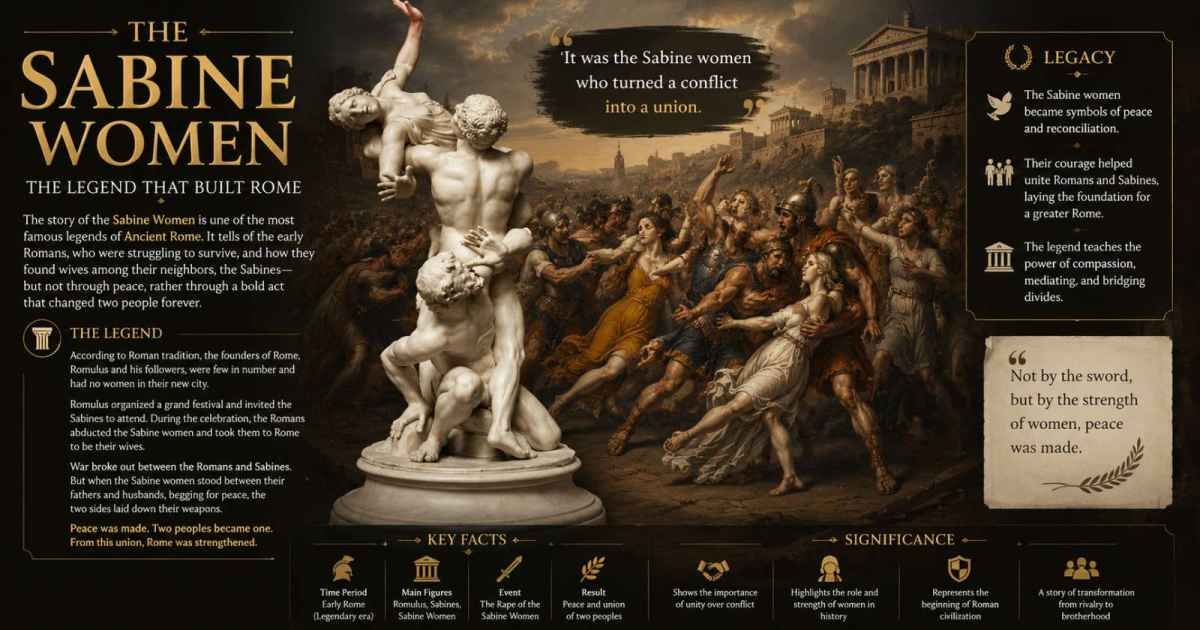
Table of Contents
ToggleThe story of the Sabine women is one of the most dramatic, controversial, and influential legends in Ancient Rome. For more than 2,700 years, it has inspired paintings, sculptures, operas, literature, and films, while continuing to spark debate among historians and archaeologists. Although the tale blends history and mythology, it played a vital role in shaping Roman identity and explaining how a small settlement grew into one of history’s greatest civilizations.
In 2026, scholars continue to analyze the legend from historical, political, and feminist perspectives. Rather than viewing it simply as a story of violence, many researchers see it as a powerful narrative about nation-building, cultural integration, diplomacy, and the remarkable role of women in shaping Rome’s future.
Who Were the Sabines and the Sabine Women
The Sabines were an ancient Italic tribe who lived in central Italy, northeast of Rome, among the Apennine Mountains. Ancient writers described them as strong, disciplined, religious, and highly respected people whose traditions influenced early Roman culture.
The Sabine women were the daughters and sisters of this tribe. Roman historians such as Livy and Plutarch portray them as women admired for their beauty, virtue, dignity, and courage. Importantly, the Sabines were not distant foreigners. They were neighbors and distant relatives of the early Romans, making the conflict even more tragic.
Their significance extends far beyond the famous legend. According to Roman tradition, these women became the first mothers of Rome, creating a bridge between two rival communities and ultimately helping establish a united Roman people.
Although modern historians cannot confirm every detail, the story reflects real themes common in early Italy, where alliances, marriages, and tribal integration were essential for survival.
The Founding of Rome and Why Romulus Needed Women
According to Roman tradition, Romulus founded Rome in 753 BC on the Palatine Hill. The new city welcomed refugees, fugitives, exiles, and adventurers, rapidly filling Rome with ambitious young men.
However, Rome faced a serious problem.
Without women, there could be no families, no children, and no future generations. A city made almost entirely of warriors could not survive long.
Romulus first attempted diplomacy. He sent ambassadors to neighboring peoples—including the Sabines, Latins, and Samnites—asking permission for intermarriage between Romans and their daughters.
Every request was rejected.
Many neighboring tribes viewed Rome as a settlement of criminals and feared its rapid growth. Allowing marriages would strengthen a dangerous rival.
Facing the possible extinction of his city within a single generation, Romulus abandoned diplomacy and devised a bold, controversial plan that would forever define Roman mythology.
The Abduction at the Festival of Consualia
The event traditionally known as the “Rape of the Sabine Women” is widely misunderstood today. The Latin word raptio actually means abduction or kidnapping, rather than sexual assault in its modern legal meaning, although the crime itself remained a serious act of violence.
Romulus organized a magnificent religious festival called the Consualia, honoring Consus, the god associated with grain storage and harvests.
Neighboring tribes, including many Sabine families, attended the celebration with complete trust.
At a prearranged signal—according to Livy, when Romulus stood and threw his cloak into the air—Roman young men rushed into the crowd and carried away the unmarried Sabine women.
Ancient writers disagree about the exact number. Estimates range from 30 to 700 women, although 30 is the figure most commonly associated with Rome’s early 30 curiae (tribal divisions).
Following the abduction, Roman men reportedly assured the women that they would become honored wives, enjoy Roman citizenship, and help establish prosperous families rather than remain captives forever.
Although deeply troubling by modern standards, ancient Roman writers presented the episode as a foundation myth explaining how Rome obtained its first generation of families.
The War Between Romulus and King Titus Tatius
The Sabines were outraged.
Fathers, brothers, and tribal leaders demanded the immediate return of their daughters. When negotiations failed, war became inevitable.
The Sabine army was led by King Titus Tatius, one of the most respected rulers in central Italy.
One of the legend’s most famous episodes involves Tarpeia, a Roman maiden guarding the Capitoline fortress. According to tradition, she agreed to open Rome’s gates in exchange for “what the Sabines wore on their arms,” believing she would receive their gold bracelets.
Instead, the Sabine soldiers crushed her beneath their heavy shields.
Her betrayal gave rise to the famous Tarpeian Rock, a cliff later used in Rome for executing traitors.
The conflict intensified as Roman and Sabine armies fought fierce battles in the valley that would later become the Roman Forum. Both Romulus and Titus Tatius proved capable military leaders, and neither side could secure victory.
The future of the young Roman state hung in the balance.
How the Sabine Women Ended the War
The most memorable moment in the entire legend came not through military victory but through extraordinary courage.
As the final battle reached its climax, the Sabine women rushed onto the battlefield.
They stood between their Roman husbands and Sabine fathers, carrying their children in their arms.
According to Livy, they pleaded with both sides:
“If you are weary of these ties of kinship, turn your anger upon us. We are the cause of war. It is better for us to perish than to live widowed or fatherless.”
Their emotional appeal transformed the conflict.
Neither army wished to kill wives, daughters, mothers, or grandchildren.
The fighting stopped immediately.
This extraordinary act changed the women’s role forever. They were no longer remembered only as abducted maidens but as peacemakers, diplomats, founders, and heroes who prevented the destruction of both peoples.
Their intervention remains one of the earliest literary examples of women exercising political influence through moral authority.
The Legacy of the Sabine Women and the Birth of a United Rome
Following the peace agreement, Romulus and Titus Tatius agreed to rule jointly.
The Sabines settled in Rome, and the two communities merged into one political body.
Together they became known as the Quirites, an early name for Roman citizens that symbolized unity rather than division.
According to Roman tradition:
- Thirty Roman curiae were named after the Sabine women.
- Roman wives received special legal honors and protections.
- The Matronalia festival celebrated women, marriage, and motherhood.
- Sabines and Romans gradually formed a single cultural and political identity.
The legend perfectly supported Rome’s image as a civilization capable of conquering, absorbing, and integrating neighboring peoples.
Rather than eliminating defeated enemies, Rome often incorporated them into its expanding state—a policy that later helped build one of history’s largest empires.
The Sabine Women in Art, Literature, and Modern Interpretation (2026)
Few classical stories have inspired artists more than the Sabine women.
During the Renaissance, Baroque, and Neoclassical periods, the dramatic scenes of abduction and reconciliation became favorite subjects for Europe’s greatest artists.
Among the most celebrated works are:
- Giambologna’s breathtaking marble sculpture The Rape of the Sabine Women in Florence.
- Nicolas Poussin’s dynamic historical paintings.
- Peter Paul Rubens’ emotionally charged Baroque interpretations.
- Jacques-Louis David’s masterpiece The Intervention of the Sabine Women (1799), which emphasizes peace rather than violence.
These works transformed the ancient legend into a timeless symbol of conflict, sacrifice, reconciliation, and national unity.
In 2026, historians continue to debate the historical accuracy of the story. Many believe the legend reflects Rome’s gradual assimilation of neighboring tribes rather than a single historical event.
Modern feminist scholarship also offers new interpretations. Instead of viewing the women solely as victims, scholars emphasize their agency, resilience, leadership, and political influence.
Questions frequently explored today include:
- Was their intervention an act of survival, diplomacy, or both?
- How did marriage shape alliances in ancient societies?
- Why did Roman writers place women at the center of their foundation myth?
Today, the Sabine women symbolize courage under impossible circumstances, demonstrating how individuals without political office or military power can reshape history through wisdom and compassion.
Conclusion
The legend of the Sabine women remains one of the most powerful stories in Ancient Roman history. Whether understood as mythology, political symbolism, or a reflection of early Italian tribal life, it explains how Rome transformed conflict into unity.
From the desperate plans of Romulus to the courage of women who stopped a devastating war, the story continues to fascinate readers more than two millennia later. It teaches enduring lessons about leadership, reconciliation, cultural integration, and the essential role women played in the birth of Roman civilization.
In 2026, the Sabine women are remembered not simply for what happened to them, but for what they accomplished. Their legendary intervention helped unite two peoples, establish lasting peace, and create the foundations of a civilization that would shape the course of Western history for centuries.

adidas Protour 3.4 Backpack: Complete Guide, Features, Size and Review
2025 Hyundai Palisade: Complete Guide to Features, Performance, Interior, and Pricing

Half-Kneeling Hip Flexor Stretch: Benefits, Proper Form, and How to Do It

Randy Jurado Ertll: A Voice for the Voiceless and the Magic of Salvadoran Storytelling

Conquering the ʻAihualama Trail: Your Ultimate Guide to Oahu’s Hidden Rainforest Gem

The Ultimate Guide to the Film “Safe Haven” (Тихая гавань) 2013: A Deep Dive into the Romantic Thriller
Trending
 Entertainment3 months ago
Randy Jurado Ertll: A Voice for the Voiceless and the Magic of Salvadoran Storytelling
- Nature4 months ago
Conquering the ʻAihualama Trail: Your Ultimate Guide to Oahu’s Hidden Rainforest Gem
- Entertainment4 months ago
The Ultimate Guide to the Film “Safe Haven” (Тихая гавань) 2013: A Deep Dive into the Romantic Thriller
- Travel4 months ago
Conquering the Makapuʻu Tide Pools: A Guide to Oahu’s Hidden Volcanic Gems
- Business4 months ago
Workflowy Templates: The Ultimate Guide to Mastering Productivity in 2026
- Business4 months ago
The Definitive Guide to WXXM Madison: From Progressive Talk to Rewind 92.1
- Fashion4 months ago
Baddie Hub: The Rise of the Internet’s Confidence-Driven Aesthetic Culture in 2026
- Fashion4 months ago
Caleb Goddard: The Diplomat Who Redefined Legacy Beyond Hollywood’s Spotlight